Welcome to my little writing craft series about what I’ve learned (or am learning) from the books I’ve been reading.
Once a month, I’ll talk about my favorite books and what they taught me about writing.
One of my teaching philosophies has always been that the more you read, the better you write. Studying the writing of others is a great way to learn about voice, structure, pacing, and other craft elements. Especially if you don’t have the money and/or time to invest in writing courses or an MFA.
For myself, I’ve recently been thinking about why I love the books that I love. I am not usually a re-reader, but after a spirited conversation with my friend, Tammy Evans, about the novel, One Italian Summer by Rebecca Serle, I was inspired to go back through my favorite novels.
And the main question I kept asking myself was: what makes a book great?
Obviously, many things make a book great, but the first, and one of the most important points, is that a book seeks to answer a compelling question.
Which made me think: what are some books with great compelling questions?
Book #1: 11/22/63 by Stephen King
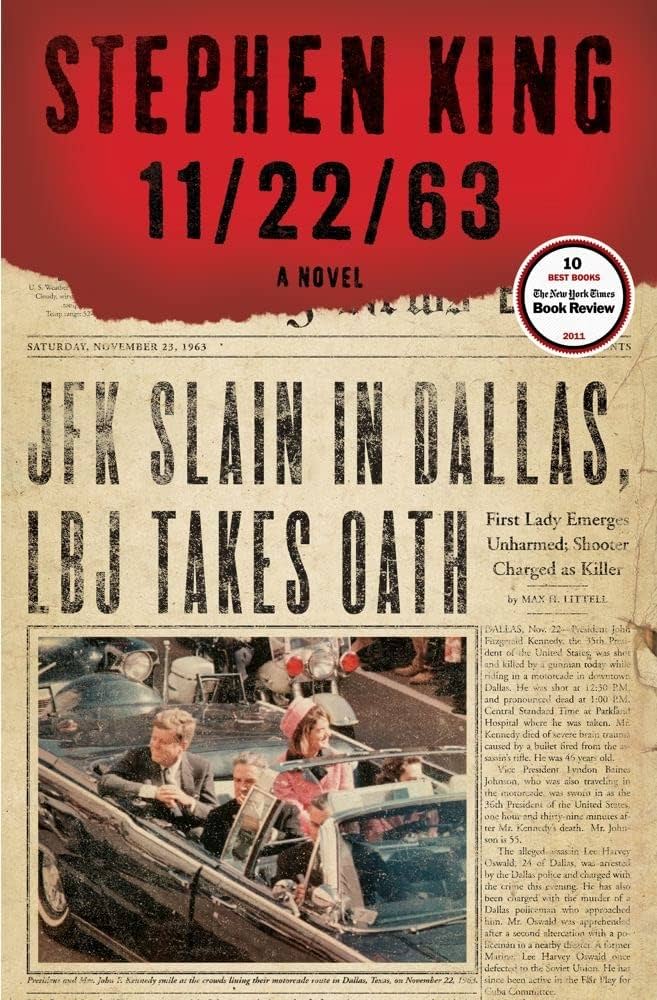
Quick Summary: In 2011, in a small town in Maine, English teacher, Jake Epping embarks on a mission to save JFK from his assassination in 1963 via a time traveling portal.
The Lesson in Action
I originally picked up 11/22/63 by Stephen King solely because of the question at the center of the book: what would have happened if JFK had never been assassinated?
I was fascinated by how King would use his story to answer the question. And while I am somewhat surprised (and disappointed) in how the story ended, I can confidently say that King did an incredible job creating a world that was both immersive and evocative.
The question around which King centered his narrative taps into a mythologized event in U.S. history. It bisected the U.S. timeline into a before and after, begging anyone who was alive during the time the question, where were you when Kennedy was assassinated?
In and of itself, taking a colossal world event and reimagining what the world would have been like had it hadn’t happened is already a fascinating place to start.
We know what happened after Kennedy died, but what if he hadn’t? How would the world be different? How would society, politics, and social reforms be different?
When you start with a compelling question, it naturally offers up other questions that you use your narrative to answer. We, the readers, want to see the world created by these answers and watch as the protagonist navigates this new world.
Book #2: The Other Side of Now by Paige Harbison

Quick Summary: On the night of her birthday, actress, Lana Lord, buys a ticket to Ireland and wakes up to the life she could have had if she had made a different choice after high school graduation.
The Lesson in Action
I am a sucker for stories with the premise of someone waking up in an alternate version of what their life could have been if the protagonist had made a different choice.
The Other Side of Now by Paige Harbison is that book. The question at the center of which is, what would happen if you woke up in a world where your best friend hadn’t passed away tragically? Alternately, the central question could be: what would happen if you woke up to a version of your life that could have been had you made one different choice?
What makes these types of stories, and this book particularly, so compelling is that they tap into a universal fascination with what our own lives would have been had we made different choices for ourselves. Imagining our lives as they could have been is deeply personal. And reading books with this premise allows the reader to experience such an event voyeuristically through the main character of work.
We may never get to experience an alternate timeline for ourselves, but we can enjoy watching someone else navigate what their life would have been like.
And writing based on a question that taps into a universal truth or fascination is a way to resonate with readers.
How It’s Impacted My Writing
It starts with a “what if” question.
For my first novel it was: what if my protagonist overheard her parents telling each other a secret in another language? Which led to: what would that secret be, and how would the secret impact the family?
The answers to those questions created ripple effects within my characters. How would the protagonist and her sister respond to the news of the secret? How would the secret impact how the parents treated their children? How does the secret unravel the normalcy of the family’s every day?
Because of one question, I was able to create more questions that fueled the dynamics and dimensions of the novel.
Using “what if” questions has been my go-to for getting started when it comes to writing stories. They have been as big as what would happen if a witch had to give up the powers that would save her life for love and as simple as what if Gina and Clint from Married at First Sight had ended up falling in love?
“What if” questions have given me space to explore all sorts of paths creatively in my writing. But also get an universal truths that have impacted us all at one point or another.
The Power of “What If”
My favorite books are ones that have a what if question at their center that explores a universal event, fascination, or truth.
These questions build dynamic characters and well developed worlds, and when I started writing stories from a place of “what if”, I found my writing became more interesting and my stories so much fuller.
What did your favorite book teach you about writing? Let me know in the comments!
Enjoyed this blog post? Like, comment, share, and subscribe to get even more writer life tips, reflections, and recommendations every Saturday!

 Robyn Neilsen